Sunday, March 22, 2015

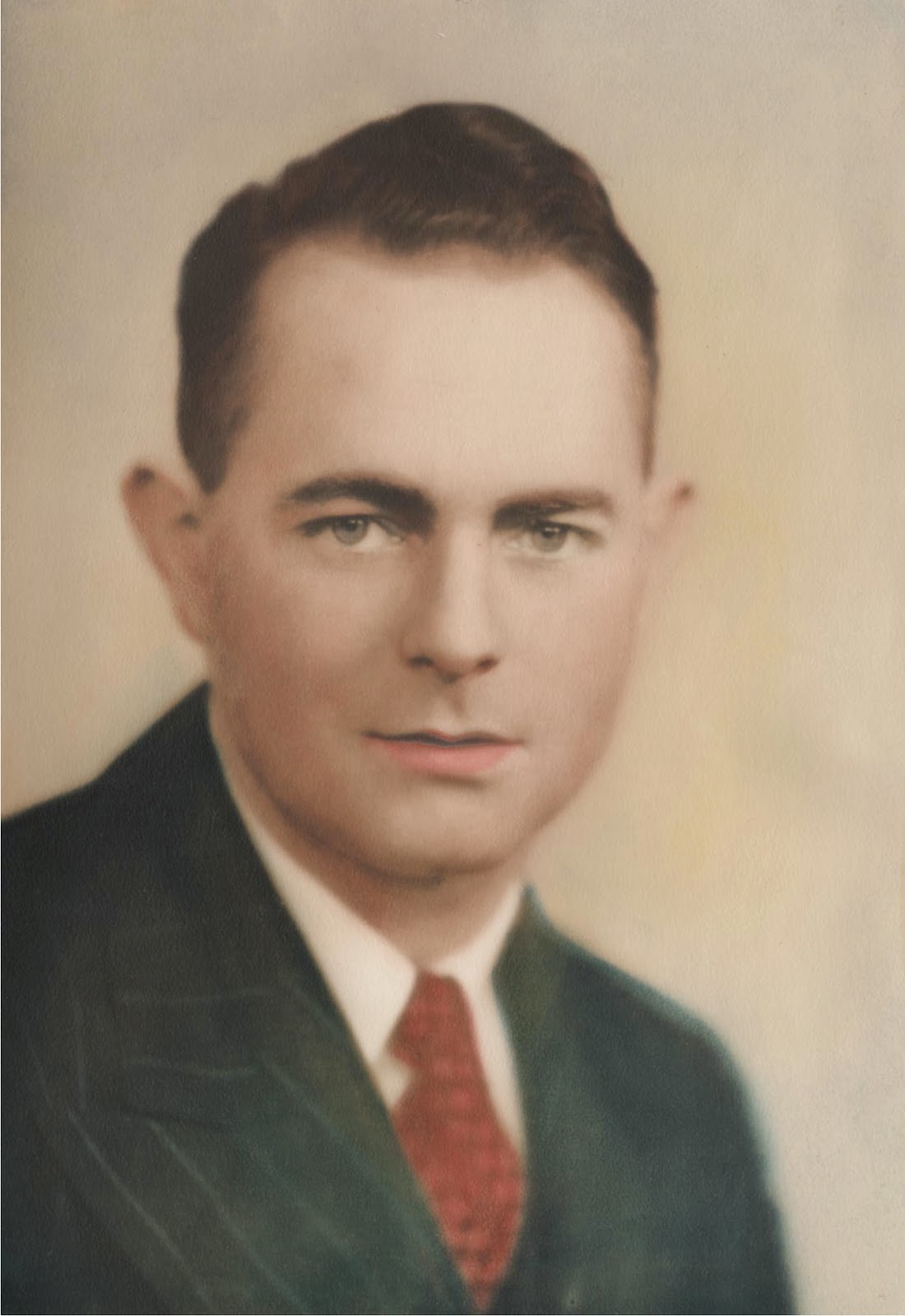
Will and Eva Overton Williams of Haywood County, Tennessee

Photo/Mary S. Williams

Click to Enlarge

Will and Eva Williams


I never knew my paternal great-grandfather, William Lafayette "Will" Williams (Feb. 13, 1888 - April 1, 1962) because he died the year before I was born.

Although I've seen several photos of him, one of my first cousins, Donna Williams Taylor, recently posted several photos to Facebook that belonged to one of his daughter-in-laws, Mary Shealy Williams.

Click to Enlarge

Will Williams and his son, Bo Williams, around the same age
and looking remarkably similar.

Will Williams was born in Haywood County, Tennessee on Feb. 13, 1888 to George D. Williams and his wife, Martha Jane Watridge.

Martha Jane died when her young son was only around 10 months old so Will never got to know his mother.

In the 1900 census, 12-year-old Will was living with his maternal aunt and uncle, George W. Castellaw and Mary E. Watridge Castellaw (Martha Jane Watridge Williams and Mary E. Watridge Castellaw were sisters). However, his father wasn't far away.

He was living right next door with his third wife, Virginia Estelle "Essie" Cobb Williams and their 15-year-old daughter, Elberta. Essie was a daughter of John Charles Warren Cobb and Penelope Trottman White.

Living next door to George and Estelle Williams were George's brother and his wife, John Nowell Williams and Mollie Cobb Williams

The Williams, Castellaw, Watridge, Cobb and White families were all early Haywood County settlers from Bertie County, North Carolina.

Click to Enlarge

Janie Williamson (upper left) and family

Will married Janie Elizabeth Williamson and on Nov. 27, 1910 they had their first child, Lloyd "Bo" Williams (my grandfather). 

Sadly, Janie died in 1914, along with their second child, a little girl named Janie Ruth. I remember looking at the photo above when I was a young boy and feeling sorry for Janie because she was the only one of my eight great-grandparents who died an early death.

According to family stories, Will had initially been so distraught over the death of his young wife that he was having a hard time getting over it. It was only when Janie's family threatened to take my grandfather away that he managed to pull it together. 

Click to Enlarge

Will and Eva Williams with their children
l to r: Bo, Ladonia and Blue Eyes

On Feb. 28, 1915, Will married 18-year-old Eva Iris Overton (Oct. 29, 1896 - Sept 5, 1970). By marrying Eva, he provided not only a stable home and a mother for Bo, but eventually, eight stepbrothers and sisters: Ladonia, Mary "Blue Eyes," W.L., Douglas, Dempsey, Betty and twins, Billy and Bobby.

Photo/Mary S. Williams

Click to Enlarge

Will Williams (upper left) with Billy Chandler
Douglas, Dempsey, Jesse, Bob (my father),
Billy and Bobby Williams

Although my grandfather was close to his stepmother, he never forgot his mother. There's a theory that you don't truly depart from the earth until the last person who has you in their memory dies. For Janie, that person would have been my grandfather. 

Photo/Mary S. Williams

Click to Enlarge

Will and Eva Williams


One of the last times we were at his house, my wife began asking him questions to find out what he remembered about his mother. He said, "I told my father I would never forget my mother so I would call his new wife, Mrs. Eva. All these years later, I never forgot my mother and still think about her from time to time."

Sharing these photos also provided a good opportunity to look at Eva's family tree.

Photo/Mary S. Williams

Click to Enlarge

Will and Eva Williams

She was the daughter of Robert Hardy Overton (July 22, 1872 - July 3, 1931) and Ladonia Jones (Oct. 1, 1874 - Jan. 31, 1899). 

Eva's paternal grandparents were John M. Overton (Jan. 27, 1842 - March 8, 1905) and Parthenia Ann Chambers (Apr. 18, 1842 - Aug. 1, 1907).

Her maternal grandparents were Joseph D. Jones (born 1850) and Zenobia Caroline Stanfield (Oct. 8, 1853 - July 10, 1891). 

It appears both parents and all four of her grandparents were born, lived and died in either Haywood or Madison Counties.

Photo/Mary S. Overton

Click to Enlarge

Will Williams in his den. I was quickly drawn to the photo
of my father and uncle in the upper right.

Eva's Overton line can be traced back to William De Overton who was born in 1270 in Cheshire, England and died in the same town in 1355.

Eva's eighth great-grandfather was Major-General Robert Overton (1609 - Dec. 22, 1679), a soldier of the Parliamentary Wars. Overton was married to Anne Gardiner.
Overton was a prominent English soldier and scholar, who supported the Parliamentary cause during the English Civil War (1642 - 1651) and was imprisoned a number of times for his views. More
In the second Civil War (1648 - 1649), Overton's regiment supported Cromwell in Wales and in 1650, accompanied Cromwell to Scotland where he commanded troops in the battle of Dunbar and was subsequently made governor of Edinburgh. On May 14, 1652, Parliament voted him 400 pounds a year and Scottish lands in return for his services. More
Her seventh great-grandfather was Robert Overton's son, William Overton. William migrated to Virginia from the family estate at Easington in England in 1669 and received a land grant of 4,600 acres on the south side of the Pamunkey River in Hanover County, Virginia for bringing 92 people to America. 

Soon after arriving in England, William Overton sent for Mary Elizabeth Waters and they were married on board her ship on November 24, 1670.

William Overton died in Jamestown in 1697. More about William Overton

On Eva's maternal family tree, her second great-grandfather, Ephraim Alpheus Stanfield, was the first of that family to migrate to Madison County, Tennessee.

The obituary from another settler, Alfred B. Joyner, from July 20, 1899 includes a mention of Stanfield.
"Another family from Bedford County, Middle Tennessee preceded the Joyners, coming in the winter of 1824-25. This was the Stanfield family. Ephraim A. Stanfield, Esq. and his wife Sarah, who brought a large family of children, all of whom, except for Dr. C.A. Stanfield of Toledo, Ark. have with the Joyners, passed over the river to rest under the shadow of the trees. This family settled north of Wellwood and were noted in many respects. Ten sons and three daughters; the boys grew to manhood, remarkable for their unusual physical and mental development, above medium size, erect, strong, active, healthy and intelligent, all except one lived to raise families, many of whose descendants are filling positions of trust and honor in Arkansas, Texas, Kentucky, etc. these two families were among the first settlers of this section."
I love how the obituary writer referred to their deaths as "passed over the river to rest under the shadow of the trees." I assume both the writer and those who read the obit had spent much time in the cotton fields of the Delta so resting in the shadow of the trees had strong meaning for them.

Stanfield and his wife, Sarah Priscilla Powell, had thirteen children and many of the members of this family are buried at Providence Methodist Church Cemetery.

Photo/Mary S. Overton

Click to Enlarge

Will and Eva Williams

As I mentioned earlier, Will died before I was born. Eva lived until Sept. 5, 1970. I was seven years old and at my grandparent's house when my grandmother, Elizabeth Castellaw Williams, received the call letting her know Eva had passed away. Her reaction made a strong impression on me at the time and is something I never forgot.


I've since heard from many people what a generous and kind-hearted woman Eva Overton was and I do think that comes through in the photos.
Eva Overton Williams Obituary 
The States-Graphic, Brownsville, Tennessee 9/11/1970
Funeral services were held at 5 p. m. Tuesday for Mrs. W. L. Williams.
Mrs. Williams, the former Eva Overton, was 74 and died suddenly Saturday at her home after suffering a heart attack.
Services were held at Brownsville Funeral Home with the Rev. H. K. Sorrell officiating. Burial was in Haywood County Memorial Gardens.
She leaves five sons, Lloyd Williams, Douglass Williams and Dempsey Williams, all of Brownsville, Billy Williams of Miami, Fla., and Bobby Williams, of Orlando, Fla.; three daughters, Mrs. Sidney Hudgings and Mrs. Ray Robinson, both of Memphis, and Mrs. Billy Chandler of Brownsville; a brother, Marshall Overton of Florida, and sister, Mrs. Eunice Campbell, of Bells; 20 grandchildren, 11 great-grandchildren.
For more blog entries, visit my Blog Home Page or to check out the genealogy research about my specific family lines, go to my Haywood County Line Genealogy Website.

Thursday, March 5, 2015

The Brantley Family: Preachers, Planters and Pioneers of the South


I was grateful last week to open the mailbox and find my copy of "The Brantley Family: Preachers, Planters and Pioneers of the South" by Ken Brantley.

As big as a phonebook and weighing in at what feels like about 25 pounds, it's the largest, most comprehensive ancestry book dedicated to one surname I've ever seen.

According to his introduction, Brantley began his research back in 1963 the old-fashioned way; he used copy machines, letters to strangers and conversations with distant relatives with whom he connected through his research.

In 1987, he established The Brantley Association of which I am proud member #647. 

It's a meaningful branch of my family tree to me because I was close to my maternal grandmother, Virginia Brantley Lovelace (Oct. 10, 1917 - Dec. 8, 2007) and we used "Brantley" as my oldest daughter's middle name.

Click to Enlarge

Henry Preston Brantley and Mary Etta Cobb
and family

As a member, I provided some details about my own Brantley line and even got my picture in the book along with Henry Day Brantley (April 1845 - Nov. 5, 1918), my third great-grandfather, and Henry Preston Brantley (Oct. 11, 1872 - May 15, 1956), my second great-grandfather.


Click to Enlarge

Henry Day Brantley and Margaret Rebecca Steele,
my third great-grandparents

Most of the Brantley families in the United States today come from the sons of Edward Brantley who, according to the book, died in 1736 in Southampton County, Virginia. 

The first of my Brantley line to live in Haywood County was Augustus Brantley (1811 - Sept. 14, 1876) who was born in Bertie County, North Carolina and migrated along with many of my other ancestors to Haywood County, Tennessee in the early 1830s.

A little side note: Augustus' son, Solomon Normon Brantley (1848 - Feb. 12, 1927), filled out one of the Tennessee Civil War Veteran's Questionnaires. While his answers reveal only a little about life on his father's Haywood County farm and the culture of the area around the time of the Civil War, it's more than I have on many of my other ancestors so I'm glad to have it.

I've already spent hours looking through this new Brantley book. In addition to more than 25,000 names and genealogical details, the book also includes maps, migration patterns, charts and lots of photos. If you're researching the Brantley family line, I highly recommend you get a copy of your own to add to your library.

For more blog entries, visit my Blog Home Page or to check out the genealogy research about my specific family lines, go to my Haywood County Line Genealogy Website.

Sunday, February 22, 2015

Iva McElroy, my wife's great-grandmother

Click to Enlarge

Iva Griffith McElroy

I usually blog about my adventures while researching my own genealogy, but for a long time I've been wanting to begin looking into the ancestry of my wife Michelle.

A few years ago, her father gave her a box of things that belonged to her paternal great-grandmother, Iva Griffith McElroy, and at the top of my list for 2015 was to explore its contents. Because I love old photos, I was especially pleased to find several envelopes of negatives included with the photos, clippings and articles that were in the box.


Click to Enlarge

Since we were snowed in this weekend, it gave me time to scan the negatives and upload them to this Flickr gallery.

Most were taken in the 1940s and while I don't know everyone in the photos, I do recognize Michelle's paternal grandparents, Rose Johnny Lee Williams. I assume Michelle's great-grandmother took most of the photos because her name is on all the envelopes. Iva had quite a talent for photography, among other things.

Iva Ann Griffith was born June 27, 1900 in Cambridge, Nebraska. According to the 1900 census, taken a few months before her birth, Iva's mother, Lethie Minerva Griffith, was the head of the household. Also living in the home was Lethie's three-year-old daughter, Mabel, and 28-year-old brother, George Arbaugh.

Iva's mother had married Charles Wesley Griffith (Sept. 27, 1846 - Mar. 20, 1908) on June 28, 1895. It's unknown where he was when the 1900 census was taken, but it doesn't seem he was living with the family. Lethie was his second wife and he had a bunch of children with his first.

Click to Enlarge

Written on the back of photo:
Lethie Griffith's Blacksmith Shop, 1905
Arco, Idaho

By 1905, Lethie had moved to Arco, Idaho where she apparently managed a blacksmith shop and by 1908, it appears she possibly married Leon R. Richards and eventually settled in Clackamas, Oregon.

In a document completed in 1957, Ida wrote her mother's name was Letha Tyson so that needs a little more research.


Click to Enlarge

In a Portland Hospital by L.M. Griffith

Lethie was also a poet as indicated by a note on a page taken from a book of poetry called "Gems of Poesy." Michelle's grandmother, Rose Reyner, wrote that her grandmother had written the poem.

Lethie died Oct. 30, 1932 at age 66.

Iva married Alvin Allen Hash (Oct. 23, 1894 - March 31, 1957) in Oregon in 1920. Their children were John A. Hash, George Hash, Rose Hash (Michelle's paternal grandmother) and William Hash.

According to the 1940 census, the family was living together in Clackamas, Oregon. From 1949 to 1951, Alvin and Iva Hash owned and operated cottages and I assume the photos from the negatives were taken around this time and are of their children and guests at the cottages.

At some point in the early 1950s, Alvin and Iva divorced and he married someone named Dollie. Alvin Hash died March 31, 1957 and was buried at the Willamette National Cemetery in Portland.

Click to Enlarge

Letter of recommendation for Iva Hash

Through the 1950s, Iva worked a variety of jobs including manager of railroad dorms, home mother at a children's home and cook at the Rainbow Inn in Lebonon, Oregon.

Click to Enlarge

Possibly Joseph Lynn McElroy

Iva met Joseph Lynn McElroy at a Billy Graham Crusade and they married in Ada, Idaho on March 14, 1958.

Click to Enlarge

Iva's clippings relating to her son's ministries

Her faith was obviously important to Iva and all three sons, John, George and Bill, became ministers.

By the time Iva met Joseph McElroy he was also a man of faith but that had not always been the case.

Click to Enlarge

The McElroy Family
(Joseph Lynn McElroy far left)

Click to Enlarge

Joseph Lynn McElroy's graduation photos

McElroy was a very successful engineer who had built many large buildings in Portland, Oregon and had been a major contributor to the building of the Bonneville and McNary dams on the Columbia River. According to family stories, the loss of his business to an unscrupulous business partner and the death of his young son left McElroy depressed and he eventually became an alcoholic.

One night God spoke to McElroy and told him he was going to become a great missionary. He never drank again and dedicated his life to sharing the Gospel.

After they were married, Iva and Joseph McElroy spent time in Jamaica as missionaries. McElroy died on Feb. 6, 1972 in Oregon City, Oregon.

Click to Enlarge

Iva (right) and her sister, May Greer

Click to Enlarge

Ida McElroy toward the end of her life

Ida McElroy died on December 26, 1975 and was buried at the Mountain View Cemetery in Oregon City, Oregon.

Iva's son, Dr. John A. Hash, founded Bible Pathway Ministries, an organization that provides devotional content and Bibles to countries around the world.

He died at the age of 90 in 2012.

For more blog entries, visit my Blog Home Page or to check out the genealogy research about my specific family lines, go to my Haywood County Line Genealogy Website.

Saturday, February 14, 2015

Brother George Williams' slaves

                                                                  Photo/Lib. of Congress

Click to Enlarge

Modern handwritten note in case: Slave nanny/white
child image came from an estate sale somewhere
in the flat lands delta area of Arkansas.

Slavery as a concept sucks. No one really disputes that now. But it's hard to get past slavery as a concept and really feel the horror that it truly was.

My ancestors who migrated from Bertie County, North Carolina to Haywood County, Tennessee in the 1830s succeeded because the Delta ended up being the perfect place for growing cotton. The more cotton they grew, the more successful they became and the more land they could acquire. And the only way they could grow that much cotton was by using slave labor.

I've been reading a lot lately about attitudes and the cultural aspects of slavery in the South in an attempt to figure out was going on in the minds of my slave-owning ancestors in the early 1800s but it hasn't really connected personally for me until this week when I began reading some of the probate documents from the estate of my fourth great-grandfather, Brother George Williams (1797 - Oct. 3, 1852).

Click to Enlarge

Probate record from the estate of
George Williams, December
term of the Madison County Court
of 1852

From the records, I know that when he died, Williams was the owner of four slaves: Milly, a woman who was young enough to be the mother of small children; Ned, Millie's son who was around three years old; Winnie, Millie's daughter who was around nineteen months old; and Henrietta, a young girl who was fifteen years old.

Click to Enlarge

Probate Record of the estate of
George Williams, Jan. 5, 1853

It seems after George died, the assets of his estate were being divided among his wife Nancy (who remarried quickly after his death), his son Solomon Williams and his grandson Hugh A. Montgomery. 

It was determined the four slaves were to be sold and the proceeds split between the family members.

The slaves were "offered at the courthouse door in Jackson, Tennessee on Jan. 1, 1853. Henrietta was sold to Anderson Delapp for $759 while the little children, Ned and Whinney, were sold to Peyton Graves. Interesting to note the family had specifically requested the two children be sold together. That begs the question, if they were empathetic enough to make that request, why not give the children their freedom? 

Milly, the children's mother, was not there to see them sold and taken away. Included in one of the documents was the simple statement "the fourth one Milly having died since the last court."

Click to Enlarge

Physical and mental evaluation of Henrietta

One document in particular provides the most insight into the minds of those for whom slavery was a normal part of society. I warn you, it's not easy to read.

Jackson
January 4, 1853

Mr. Stephens

Dr. Fenner and myself have examined the girl Henrietta belonging to the Williams Estate and as to the state of mind think her about a smart and sensible as she looks to be just the plain ordinary amount of intellect of a coarse field hand. No reasonable ground of objection on this score.

As to the health of body she is in one important particular (of the state of her monthly periods) unsound and from the statement of the negro confirmed by statement of Mrs. Williams has been so since the spring of 1852.

We do not apprehend that she is incurably so but it will require exemption from exposure and skillful medical treatment to give her the best chances for relief from the suppression of the important function and if not relieved (for this often obstinate) her value as a breeding woman would be destroyed and her general health after some time might be so undermined as to lessen decidedly her usefulness as a working hand.

Respectfully submitted by A. Jackson 

The sale of all three slaves was later "set aside" and it was determined that they would be sold "as such time as petitioners shall instruct the court."

This is a story with details I'll never be able to figure out and it generates a lot of questions that will never be answered. 

After the Civil War, many slaves took on the names of their owners so it's just possible the siblings Ned and Whinney took the last name Williams. Ned Williams would have been born in Madison County, Tennessee in 1848 and Whinney Williams would have been born around 1850. Their mother's name was Milly.

I'll never understand how anyone could justify or explain the atrocities of slavery, but by writing about these four, at least I'll make certain their sacrifice is remembered somewhere.

For more blog entries, visit my Blog Home Page or to check out the genealogy research about my specific family lines, go to my Haywood County Line Genealogy Website.

Sunday, February 8, 2015

More details about Brother George Williams discovered

One question those of us who claim genealogy as a hobby often hear is, “how far back have you gotten?”

When asked (and frequently without being asked) I can tell you about one of my sixth great-grandfathers, John Baptist Lovelace, born in 1712 in Baltimore or one of my seventh, James Castellaw, born in 1685 in Renfrewshire, Scotland. I can tell you all about one of my eighth great-grandfathers, Richard Cobb, who was born in the mid 1500s and was educated at Oxford or his son who arrived in Jamestown in 1613.

And the Marbury side? No lie. I can go all the way back to Alexander the Great.

Since Williams is my surname, it’s the branch of my tree I would really like to be able to track as far back as possible. Unfortunately, I've never been able to get the Williams family beyond my fourth great-grandfather, Brother George S. Williams who was born in 1797 in North Carolina.

Click to Enlarge

Will Williams, Lloyd "Bo" Williams and Bob Williams

Brother George S. Williams was the father of Solomon “Sol” Williams who was the father of George D. (probably Dempsey) Williams who was the father of Will Williams who was the father of Lloyd “Bo” Williams, who was the father of Bob Williams who was the father of me. 


Click to Enlarge

Holly Grove Baptist Church
Bertie County, North Carolina

Until last week, what I knew about George was that in 1833 he was a minister leading a congregation at the Holly Grove Baptist Church in Bertie County, North Carolina. Around this time, many of his friends and family were migrating from Bertie County to Haywood County, Tennessee.

Click to Enlarge

Zion Baptist Church in Haywood County, Tennessee

One of the first things they did when the got to their new home was to set up a church where they could worship. By 1836, they needed a full-time minister for their church, which they had named Zion Baptist Church. They wrote Brother George and his wife Nancy (I do not yet know her last name) and they moved from Bertie County, North Carolina to Haywood County, Tennessee where Brother George became one of the early pastors of the church.

Click to Enlarge

1950 Census Record of Brother George and Nancy Williams
in Madison County, Tennessee

In 1850, the United States census shows that George (age 53), his wife Nancy (age 40) and their daughter, Harriet (age 17), were living in Madison County, Tennessee, which is just adjacent to Haywood County. His occupation was listed as “Baptist Minister.” They were living next to their son's family (my third great grandparents), Solomon Williams (age 30), Catherion Arthur Nowell Williams (age 23), and their children, Elizabeth (age 6) and George (age 4 months).

The Montgomery family, living on the other side, never seemed relevant to my research so I have always ignored them.

That’s pretty much all I knew about Brother George Williams. He just kind of disappeared after that.

Until last week, that is. I received an email from my cousin Betsy who had gotten an email from Deb, a fellow genealogy researcher who was exploring her Montgomery family line.

As it turns out, Brother George Williams had a daughter named Mariah who married Hugh A. Montgomery on December 7, 1843 in Madison County, Tennessee. Together, they had a son, James Alexander Montgomery, who was born around 1845. This was the Montgomery family living next door to Brother George and Nancy. Mariah Williams Montgomery died very young and her husband remarried. George died soon after and Nancy, his wife, remarried a man named Edward Williams (brother of George perhaps?).

Deb and I emailed a bit and she suggested I check out the files on Family Search she had been using for research and I found even more info to help fill in some blanks on these ancestors.

The settlement of George’s estate and distribution of his land created quite a stack of legal documents for the Madison County probate Court.

Click to Enlarge

Survey of George Williams land left to his descendants

Multiple surveys of their property were commissioned so the land and property could be divided correctly.

Nancy Williams, the widow of George, sold 100 acres to her son Solomon. However, George left the adjoining land to his grandson, James Alexander Montgomery, who was a minor at this time.

Click to Enlarge

Signatures on legal documents dividing property of George Williams

It's interesting to see the signatures of my fourth great-grandmother, Nancy Williams, and my third great-grandfather, Solomon Williams, on sone of the documents that were signed more than 160 years ago.

In several places George’s death is stated as occurring on “the 8th of December 1854, but in other places it states “…Rev. George Williams departed this life intestate on the 3rd day of October 1852.” That seems more likely the correct date.

In one document, Nancy is refered to as “Nancy F. Williams” which adds another clue that I may be able to use to help identify her later.

But the best news of all came in the form of additional information provided by Deb that indicates the possibility of the location George's burial place. I've always wondered why George Williams wasn't buried at Zion since he was such a big part of the history of that church.

The Montgomerys buried some of their family members on their land. Deb's research indicates there were at least seven family members buried there, including Mariah Williams Montgomery. The chances are quite good that George Williams could have also been buried in the cemetery alongside his daughter.

                                                                                            Photo/Deb Kueter
Click to Enlarge

What remained of the Montgomery Family Cemetery in 1995

Unfortunately, a housing development called Walnut Trace was built close to the cemetery along Cooper Anderson Road in Madison County so its very likely nothing remains there today.

In the coming weeks I'll be posting more results from this research about the Williams family.

For more blog entries, visit my Blog Home Page or to check out the genealogy research about my specific family lines, go to my Haywood County Line Genealogy Website.

Sunday, February 1, 2015

An account of the remarkable occurrences in the life and travels of Colonel James Smith

Click to Enlarge

John Wayne as Colonel James Smith
in "Allegheny Uprising."

Although my ancestors migrated from North Carolina and settled West Tennessee in the early 1830s, they weren’t the first to find the area appealing. Indians like the Chickasaw were using it as a camping and hunting ground for thousands of years before the wagon trains began unloading.

In school, the role of Indians was always part of our early Tennessee History curriculum and most Memphis-area youngsters growing up in the '60s and '70s could count on at least one field trip to Chucalissa Indian Village. It's not even all that unusual to stumble across flint arrowheads in the area, although I've never been that fortunate. While playing in the woods as a young boy, I frequently entertained the idea that an Indian possibly walked over the very spot on which I was standing. 

Click to Enlarge

Title page of Colonel James Smith's book.

If you happen to have an interest in the Indians of the early colonial period, you may enjoy a book I just finished that's available for free download or in hardcover

“An Account of the Remarkable Occurrences in the Life and Travels of Col. James Smith, Consisting of an Autobiography and an Analysis of Indian Culture” was written by Smith in 1799, 40 years after his capture and captivity by Indians.

In 1755, when he was 18 years old, Smith was part of an army of 1,400 who were sent to attack the French army at Fort Duquesne (now known as Pittsburg) as part of General Edward Braddock’s British Regiment. In his book, Smith claims he was taken captive by a band of Lenape Indians and stayed with them nearly five years.

Although initially beaten and tortured, he was eventually adopted into the tribe and became one of them. This excerpt, which takes place early in his story, shares what happened at the end of the adoption ceremony and is a great example of Smith's style of storytelling. 
"The old chief, holding me by the hand, made a long speech, very loud, and when he had done he handed me to three squaws, who led me by the hand down the bank into the river until the water was up to our middle. The squaws then made signs to me to plunge myself into the water, but I did not understand them. I thought that the result of the council was that I should be drowned, and that these young ladies were to be the executioners. They all laid violent hold of me, and I for some time opposed them with all my might, which occasioned loud laughter by the multitude that were on the bank of the river. At length one of the squaws made out to speak a little English (for I believe they began to be afraid of me) and said, 'No hurt you.' On this I gave myself up to their ladyships, who were as good as their word; for though they plunged me under water and washed and rubbed me severely, yet I could not say they hurt me much." 
His account of his years with the Indians is especially interesting because of his observations and reporting on the tribe’s social structure, religious beliefs and attitudes about Europeans who were settling around them in increasing numbers. 

Smith was one of many around this time who published accounts of first-hand experiences of living with “savages.” These captivity narratives were often based on actual experiences but many contained fictional elements used either to make a point or to make the story more sensational.

After his nearly five years living with the Indians, Smith escaped to Montreal where he was captured by the French and held for four months until being traded in a prisoner exchange with the British. Upon his return home, he said his friends and family "found him quite like an Indian in his walk and bearing."

In later years, Smith led the “Black Boys” a group of men from Pennsylvania who, ten years before the American Revolution, rebelled against the British. He eventually became a legislator in Kentucky, a Presbyterian missionary and a writer. 

Smith died on his farm in Kentucky around 1812. 


The film “Allegheny Uprising” was loosely based on Smith and the Black Boys Rebellion and stared John Wayne as Smith.

For more blog entries, visit my Blog Home Page or to check out the genealogy research about my specific family lines, go to my Haywood County Line Genealogy Website.

Wednesday, December 31, 2014

Ridley Wills, Haywood County Fugitive

Click to Enlarge

William Ridley Wills
1898 - 1957

In the early 1920s, a group of fifteen or so writers, poets and literary scholars who were students and faculty at Vanderbilt University in Nashville, Tennessee, came together and, without meaning to, created what became a literary movement.

Eventually, the goal of the Fugitives, as they called themselves, was to shift the world’s perception of southern writers away from mint juleps, slaves in cotton fields and poverty. They wanted to show that writers in the South could produce "intellectual work," particularly poetry, equal to or better than that being written elsewhere in the world. 


Video: In the early 20th century, a coterie of poets
gathered in Nashville, Tennessee, determined
to redefine the way the world viewed the south.


I happened to notice one of those men, Ridley Wills, was born in Haywood County, Tennessee so I did a little poking around to see what I could find out about him.

Wills was born March 4, 1897 to lawyer Asa Mann Wills and his wife, Della Belle Womack Wills, in Brownsville, Tennessee. He was named after his father’s brother, Nashville businessman Ridley Wills, who was the founder of National Life and Accident Insurance Company. 

Of course, I’m always curious if there is a connection to my own family tree.

Ridley Wills’ paternal grandmother, and the inspiration for his father’s middle name (Mann), was Elizabeth Cousins Mann. Through this ancestor, Ridley Wills and I have a minor family connection. Velma Irene Castellaw, a sister of my paternal grandmother, Elizabeth Castellaw Williams, married Abner Bertheer “Bear” Mann who was also a descendant of that same Mann family line. 

I remember well my grandmother talking about Bear Mann and the half-bear, half-man image it conjured up in the mind of a young boy.

Checking the census of 1900, you find Ridley Wills was three years old and living in the seventh district of Brownsville with his older sister, Trousdale, and his parents. The Wills family lived with or next door to the families of Thomas Mann and his son, Vernon Mann so these were likely relatives of Ridley Wills’ mother.

Ten years later, the census of 1910 shows the family was still living in Brownsville and 13-year-old Ridley then had two younger sisters, Harriet and Elizabeth.

On July 25, 1917, when he was nineteen, Ridley Wills left Vanderbilt University, where he was attending college, and enlisted in the Army. According to several sources, Wills was glad to be leaving college and the faculty was glad to see him go.
“In his student days Wills had been an irrepressible journalist and prankster...involved in all sorts of skirmishes and practical jokes. Just before the end of school in 1917, Wills, as one of the editors of The Hustler, had written a column defending a few freshmen who were about to be expelled from school for throwing water on a faculty member from an upstairs window. In his editorial Wills emphasized the difference between such boyish pranks and really serious matters, such as cheating. 
Apparently the authorities did not approve of his defense, and when he left school to join the army, it was with some relief on both sides. When he returned, he was as bright and flippant as ever. 
By virtue of having published a novel he felt a certain authority in literary affairs and accepted as his duty the task of enlivening the intellectual life on the campus." 
Cowen, Louise. The Fugitive Group. Baltimore, MD: J.H. Furst Company, 1959.
In the Army, Wills served as a Second Lieutenant in France and Germany during World War I and was honorably discharged on August 16, 1919.

He then returned to Vanderbilt University where, along with his younger cousin, Jesse Wills, he was invited to become a member of the Fugitives, which had begun a few years earlier.

Wills connected with Allen Tate, one of the leaders of the group and the two quickly became friends. According to an article in The Sewanee Review:
“The two young men at that time of their lives were like twins: charming, witty, arrogant, and not only beyond the class of 1923 but also, they felt, a little beyond the too-serious older Fugitives.”  
Buffington, Robert. High Jinks in Nashville, 1923The Sewanee Review. Baltimore, MD: The John Hopkins University Press, Spring, 1979.
Many years later, Tate would recall that Wills was “small, graceful, ebullient, and arrogant, and one of the wittiest and most amusing companions I ever had.”

Just for fun, Tate and Wills produced a book of poems that was a parody of both the Fugitives and of T.S. Elliot's The Waste Land

Click to Enlarge

The Golden Mean and Other Poemsby Ridley Wills and Allen Tate

They are said to have written The Golden Mean in one night and it was published locally in Nashville in 1923 to positive reviews. A much sought-after book for collectors today, you can have a copy of your own for just $3,500.

Tate, who was a poet, essayist and social commentator, later became Poet in Residence and founded the creative writing program at Princeton University and was Poet Laureate Consultant in Poetry to the Library of Congress from 1943 to 1944.

Click to Enlarge

Hoax
by Ridley Wills

Wills published two novels of his own. Hoax (1922) was about a young man from the age of eighteen to twenty-seven and is set in West Tennessee. It was written in New York where he lived after being discharged from the army. His second novel, Harvey Landrum (1924), was written after he graduated from Vanderbilt and is a psychological study of a young man who "tries to hide a sense of inferiority behind a false sense of bravery." The setting of his second novel is Jackson, Tennessee.

When I discovered what books he had written, I immediately wanted them in my collection of novels by West Tennessee authors and I did find them online. Not quite as collectible as The Golden Mean, you can purchase Hoax for $489.95 and Harvey Landrum for a mere $275.00.

A little steep for my book-buying budget but, since I am blessed to live so close to the Library of Congress, I hoped to be able to at least read them there. 

Click to Enlarge

Harvey Landrum at The Library of Congress
by Ridley Wills

While the Library of Congress did have a copy of Harvey Landrum in their offsite storage facility, the closest copy of Hoax is at the University of Virginia. Guess I’ll save that one for the next college visit with my daughter.

After graduation, marriage to Louella Wilson and a move back to New York, Wills wrote for the New York Herald then launched his own newspaper, The Rye, New York Courier. He wrote a friend back in Nashville, “Our aim is to make an international local sheet of it with literary qualities.” Cowen, Louise. The Fugitive Group. Baltimore, MD: J.H. Furst Company, 1959.

During his career Ridley Wills also wrote for several Tennessee newspapers including the Memphis Press Scimitar and the Memphis Evening Appeal, eventually becoming an associate editor of the Commercial Appeal.

He later wrote for and served as the continental editor of the Cincinnati Star Times

According to Wikipedia, Wills was the father of five children: Andrew, William, David, Tookie, and Thaddeus.

Ridley Wills' father, Mann Wills, and his uncle and namesake, Ridley Wills, established the much-needed Haywood County Memorial Hospital in 1930. 

Click to Enlarge

Tennessee Governor's Mansion

In 1949, the State of Tennessee purchased the family home of the senior Ridley Wills and it has since served as the Governor's mansion. "Far Hills" sits on 10 acres and features beautiful views from many of the 16 rooms of the three-story home.

Brownsville's Ridley Wills spent the last four years of his life as a patient at the Bay Pines Veterans Hospital in Florida where he also served as the editor of the hospital newspaper. He died on September 8, 1957 and was buried at Bay Pines National Cemetery in Pinellas County, Florida.

Wills' cousin and fellow Fugitive went on to work in the insurance business like his father. In 1969 he established the Jesse W. Wills Fugitive and Agrarian Collection at the Vanderbilt Heard Library. 

Click to Enlarge

The Fugitive

The Fugitives published 19 issues of The Fugitive magazine from 1922 to 1925 and there were never more than 200 subscribers. Copies of the magazine are extremely rare and each issue is now worth more than $20,000. In addition to copies of the magazine, The Wills Collection at the Heard Library includes more than 1,600 books and monographs by and about the Fugitives and Agrarians, as well as a large collection of the writers’ letters, papers and published magazine articles.

If you happen to be interested in this topic, one article I came across, Pride and Prejudice: The thorny legacy of Vanderbilt's Fugitives and Agrarians, does a great job of exploring this fascinating aspect Southern history and literature.

For more blog entries, visit my Blog Home Page or to check out the genealogy research about my specific family lines, go to my Haywood County Line Genealogy Website.