Saturday, December 29, 2012

Photos from 1960s Suburbia in an Old Red Wallet


I
was looking through boxes of old photos at my parent's house during the holidays and came across this old red wallet crammed full of small Polaroids taken in the 1960s. They feature my family at home, at work, with friends, and on vacation nearly 50 years ago.
 
I had not seen most of the photos before so it was a great find.
 
While both my parent's ancestors had lived and farmed the same land in Haywood County, TN since the early 1830s, they were part of the postwar baby boomer trend of leaving farms and rural communities and moving to the cities and suburban communities.  

They purchased one of the first lots in a planned community called Parkway Village in Memphis that, at the time, was mostly cotton fields and dirt roads.

The chemicals on the photos are fading giving them a ghostly vintage look that no iphone filter could replicate so I scanned them and left them as they were, other than adjusting the contrast on some to bring out the detail.

In Haywood County

Click to Enlarge
Click to Enlarge
Click to Enlarge
Click to Enlarge
Click to Enlarge
Click to Enlarge

Home Sweet Suburbs

Click to Enlarge
Click to Enlarge
Click to Enlarge
Click to Enlarge
Click to Enlarge
Click to Enlarge
Click to Enlarge
Click to Enlarge
Click to Enlarge
Click to Enlarge

The Office

Click to Enlarge
Click to Enlarge
Click to Enlarge

Vacation

Click to Enlarge
Click to Enlarge
Click to Enlarge
Click to Enlarge
Click to Enlarge
Click to Enlarge
Click to Enlarge

Friends and Family

Click to Enlarge
Click to Enlarge
Click to Enlarge
Click to Enlarge
Click to Enlarge

Click to Enlarge
Click to Enlarge
Click to Enlarge
Click to Enlarge
Click to Enlarge
Click to Enlarge

For more blog entries, visit my Blog Home Page or to check out the genealogy research about my specific family lines, go to Haywood County Line Genealogy Page.

Sunday, December 9, 2012

Finding Castellaws and Cobbs at the National Archives

Pennsylvania Ave. Entrance to the National Archives

Since moving to Washington, D.C., a research trip to the National Archives has been at the top of my list of things I wanted to do. A recent Saturday morning with nothing planned gave me a great opportunity to check it out. I only had time that day for a few quick searches in their Civil War database but, in a matter of minutes, I found some family. As is usually the case when researching Haywood County, the Castellaws rose quickly to the surface.

The National Archives was formed in 1934 by President Franklin Roosevelt. Until then, individual agencies kept their own records and most were disorganized and had been damaged due to improper archiving.

The archives is housed in a beautiful building which I am fortunate enough to pass each day on my way to work.

In addition to the Declaration of Independence, the Constitution and the bill of Rights, according to their website, there are approximately 10 billion pages of textual records; 12 million maps, charts, and architectural and engineering drawings; 25 million still photographs and graphics; 24 million aerial photographs; 300,000 reels of motion picture film; 400,000 video and sound recordings; and 133 terabytes of electronic data.

In other words, a lot for a fan of genealogy to explore.

I'm official.

For me, it was fun just going through the process of getting registered to be able to enter the research area. The National Archive has produced a great video about using the facility.


One of the first documents I found includes three individuals who each show up in my genealogy and represent both sides of my family. From the “Unfiled Papers and Slips Belonging in Confederate Compiled Service Records” I located archive # 2133276.

Unfiled Civil War Document #2133276
State of Tennessee
Haywood County
Personally appeared before me Thomas J. Castellaw and made oath in due form of law that George W. D. Castellaw is his son about 18 years old was taken from my house as a conscript by ? John H. Hicks men under guard by them and in a very few days was captured in Ripley Lauderdale County by Col. Wolfe command
Sworn to before this 10th March 1864 me John H. Cobb Justice of the Peace in and for the County of Haywood
Signature: Thomas J. Castellaw
John Hardy “Jacky” Cobb, the Justice of the Peace and one of the original settlers of Haywood Co., TN, wrote this legal document for Thomas Jefferson Castellaw.

Jacky and his wife, Harriet Castellaw Cobb are of particular interest to me because their son William Thomas Cobb is my maternal third great-grandfather while their daughter, Mourning Adeline Cobb Watridge is my paternal second great-grandmother. That makes them both my third and fourth great grandparents.

For the record:
Jacky and Harriet’s son, William Thomas Cobb, was the father of Mary Etta Cobb Brantley who was the mother of Willie Day Brantley who was the mother of Virginia Brantley Lovelace who was the mother of Shirley Lovelace Williams who is my mother.

Jacky and Harriet’s daughter Mourning Adeline Cobb Watridge was the mother of Zula Zera Watridge Castellaw who was the mother of Elizabeth Castellaw Williams who was the mother of Bob Williams who is my father.
My second great-grandfather, Henry Brantley described Jacky Cobb to his grandson, L.A. Cobb when he said:
"I remember your grandfather as being short in stature. His physique was of the roly-poly type. I remember him driving up to sales in a two wheel ox cart."

Cobb, Joe H. (1983). Nicholas Cobb Descendants, Neighbors and Relatives. Nashville: M. L. W. Publishing Company
 
T.J. Castellaw, who initiated the document, was the brother of Jacky’s wife, Harriett, and my third great-grandfather on the other side of my family.

Tom and Harriett Castellaw were the only two siblings of John Dawson and Zilpha Spruill Castellaw.

John Castellaw is said to have led many wagon trains from Bertie County, NC to Haywood County, TN in the early 1830s, finally settling in the area with his wife and adult children in 1834.

Thomas Jefferson Castellaw Jr. with wife Nancy Johnson
and his son Bob Castellaw with wife Zula Zera Watridge

Eventually, T. J. had seven children with two wives. His oldest son with his second wife was Thomas Jefferson Castellaw, Jr., my second great-grandfather.

The document I found at the National Archives shows that, T.J.’s son, George W. D. Castellaw, was 18 and at his parents home near the current location of Holly Grove Baptist Church when he was forced into Civil War service by “John Hick’s men.” In just a few days he was captured by "Col. Wolfe's command" and, I assume, became a prisoner of war.

The document doesn’t indicate if George had returned home at the time this document was written but I do know he had made it back to Haywood County by Nov. 25, 1866 when he married Mary Emily Watridge.

It does give me more to add to the list of things to find out.

At the end of his life, T.J. suffered from what some thought was Parkinson’s Disease and lived with George and Mary which is mentioned in his obit:
T.J. Castellaw Obituary
"Brother T.J. Castellaw. Sr. died the 23rd December 1878 at the residence of his son, G. W. Castellaw, near Jones Station. T. J. Castellaw Sr. died in the 71st year of his age. He was born in Bertie County, North Carolina on the 15th September 1808. He moved to Haywood County, Tennessee while young. He married Mary Cole at age of thirty-one years. He professed religion about 1839 and joined Zion. He was a sufferer for many years before died."
Although no headstone remains, it's likely T. J. was buried in the Castellaw Family Cemetery on Poplar Corner Rd.

I have one additional connection to George and Mary Castellaw.

The 1900 census indicates their nephew, 12-year-old Willie Williams, was living in their home.

Will Williams with wife Eva and a grandchild.

Willie grew up to be Will Williams, my paternal great-grandfather. However, no one in my family is aware of many details of Will’s childhood so the reasons he was not living with his parents is unknown.

For more blog entries, visit my Blog Home Page or to check out the genealogy research about my specific family lines, go to Haywood County Line Genealogy Page.

Sunday, November 11, 2012

Checking Out Robert E. Lee's View of Washington, D.C.

Visiting Arlington House, The Robert E. Lee Memorial in Arlington, VA

Earlier this year, I picked up a copy of "Robert E. Lee, a Life" by humorist, Roy Blount, Jr. While it looks like a great book, so far I've only had time for a quick scan. Reading it is at the top of my "to-do" list, especially now.

Yesterday, my family and I visited Arlington Cemetery and I was pleasantly surprised to stumble upon Arlington House, The Robert E. Lee Memorial.


Gardens at Arlington House which were
originally planned by Mary Anna Randolph Custis

Arlington House was actually owned by Lee's wife, Mary Anna Randolph Custis, but it was a place of great importance to Lee. Six of their seven children were born in the house and, although he traveled a great deal, Lee seemed to think of Arlington House as his home.

The view from the front Arlington House
After the death of his father-in-law, Lee because the overseer of the estate. According to the National Park Service's website:
"Between 1857-1861, he attempted to reorganize the slaves into a more efficient labor force, cleaned up the grounds, hired a new overseer and supervised the planting of crops. He also oversaw extensive rebuilding around the plantation. He virtually rebuilt the overseer's house at the farm and the stable west of the mansion. He also fixed the roof of the mansion and took out a fire insurance policy on the mansion and the barn."
After Lincoln offered Lee the position of Commander of the Union Army, Lee is said to have made his decision to resign in his bedroom on the second floor of Arlington House. He wrote his letter resigning from the Union Army on the night of April 20, 1861. Two days later, he left for Richmond to join the Confederate Army, and would never live at Alexander House again.

Because of the war, Lee worked hard to convince his wife to leave her home. She finally agreed and left with her daughters and everything they could carry on May 15, 1861 and spent most of the war in Richmond.

The Union Army occupied Arlington House soon after she left and it became the headquarters of the Union's Army of Northeastern Virginia.

The article about Arlington House on Wikipedia states that, during the Civil War, the site was chosen for Arlington National Cemetery to make certain Lee and his family would never be able to return to their home.

Mary Lee did visit Arlington a few months before her death in 1873. Her memories of that day can be found on the National Park Service website:
“I rode out to my dear old home but so changed it seemed but a dream of the past—I could not have realised (sic) it was Arlington but for the few old oaks they had spared & the trees planted by the Genl and myself which are raising their tall branches to the Heaven which seems to smile on the desecration around them.”

Custis-Lee Family Tree on display at Arlington House

I do have a distant family connection to Robert E. Lee which I have blogged about in the past.

My 10th great-grandparents, Colonel William Randolph and Mary Royall Isham Randolph were Lee's third great grandparents. The Randolph's daughter, Elizabeth Randolph Bland, was the mother of Mary Bland Lee who was was Robert E. Lee's second great-grandmother.

For more blog entries, visit my Blog Home Page or to check out the genealogy research about my specific family lines, go to Haywood County Line Genealogy Page.

Sunday, September 2, 2012

An Outlaw Family Bible and a Lesson on Mormonism

Click to Enlarge

I was recently given the opportunity to check out a family Bible that had belonged to my fourth great grandparents, George and Luday Perry Outlaw.

In case you are researching Outlaw Family Genealogy and landed on this page of my blog from a Google search, I hope these names and dates will help you fill in some blanks on your own family tree.

George took the time to record our family genealogy for the future and I'm glad to have the opportunity to continue to preserve it.

Click to Enlarge

l to r: Elizabeth Temperance Outlaw Cobb, Mary Etta Cobb Brantley,
William Day Brantley, Virginia Brantley Lovelace
and Shirley Lovelace Williams

George and his wife, Luday, were the parents of Elizabeth Temperance Outlaw Cobb, who was the mother of Mary Etta Cobb Brantley, who was the mother of William Day Brantley, who was the father of Virginia Brantley Lovelace, who was the mother of Shirley Lovelace Williams, who is my mother.

Click to Enlarge

On one of the first pages of the Bible is written, "Geo W Outlaw's Book."

Click to Enlarge

The illustration on another of the first pages of the Bible is titled, "Moses Found" and, according to the caption was, "Drawn and Engraved by O. H. Throop, Merchants Exchange N. York."

After a little online research, I can share that Orramel Hinckley Throop was born 12 Jun 1798 in Lebanon, CT.

By 1820, he had a business card which you can check out here. His office was "over the Portland Bank on Middle Street" and his occupation was "engraver." From 1823 to 1824, he and his brother, David Throop worked together in Portland, then from 1825 to 1831 he worked in New York.

He must have liked travel and adventure because in 1832, he took his engraving business to New Orleans. That was short-lived and finally, from 1845 to 1850, he worked in Richmond, VA.

The Smithsonian American Art Museum has one of his engravings in their collection but it is not currently on display. One of Throop's engravings is also in the collection of The Metroplitan Museum of Art. You can find the information about "American Hotel, 229 Broadway, Opposite the Park, New York" on their site but there is no image.


Click to Enlarge

The language used on the title page is interesting in that it gives a great deal of information on the history of this particular Bible which was printed in 1828.
"H. & E. Phinney's Stereotype Edition, The Holy Bible containing the Old and New Testaments translated out of the original tounges and with the former translations diligently compared and revised with Canne's marinal notes and references to which are added an index; an alphabetical table of all the names of the old and new testimaents, with their signifcations; tables and scripture weights, measures, and coins, &c.,
Cooperstown, (N. Y.), stereotyped, printed and published by H. & E. Phinney, and sold by them at their book-store, and by booksellers generally in the United States. 1828"
You can find a lot of info available online about the publishers, Henry and Elihu Phinney Jr.

Now for the lesson on Mormonism.

I found it particularly interesting, considering the Grand Old Party's current presidential candidate, and my lack of knowledge of the history of the Mormon faith, that a copy of this very same version of the Bible was used by founder Joseph Smith as reference for his own translation of the Bible.

While my ancestors were using this Bible to record their history in Tennessee, Joseph Smith was in Western New York using his copy to create a book that would launch a religion.

According to The Philadelphia Rare Books and Manuscripts Company:
"He (Smith) claimed to have been especially inspired by God to restore the true original text of the Scriptures, which had been corrupted by copyists, editors, and revisers. Using a copy of this edition, including the Apocrypha, as his basis, he proceeded—without benefit of knowing ancient languages and entirely by revelation—to dictate additions, deletions, and changes to the text, which were written down by elders of the Mormon Church and incorporated into what became known as the Joseph Smith translation. This process of revision or “translation” was begun in 1830 and the bulk of it was completed by the end of 1833. The result is a unique text that differs from the Authorized Version in at least 3,410 verses, as well as substantially differing from all other versions of the Bible. Many of the changes made purport to correct verses that imply that God is the author of evil, while some others are on unique points of Mormon doctrine."

While the Outlaw family did not start a religion, they did record a great deal of genealogy information.

Family members whose births are recorded in the Bible are:

Click to Enlarge

Click to Enlarge
Page 1 (note: I transcribed the way information was originally written)

George Washington Outlaw the son of Jacob and Winnaford Outlaw his wife was borned on Sept 18 1803
Luday Perry was borned May 6th 1800

Andrew Jackson Outlaw the son of George Outlaw and Luday his wife was born March 22 1825

Harriet Ann Outlaw the daughter of George Outlaw and Luday his wife was borned june 1st 1829

Martha Winnaford Outlaw the daughter of George Outlaw and Luday his wife was borned April 3rd 1832

Ludy and George W. Outlaw left North Carolina with his family for the ? in the year 1831 and settled in Madison County Tenn 1832

Jacob Outlaw the son of George W. Outlaw and Luday his wife was borned Sept 1st 1831

Elizabeth Temperance Outlaw the daughter of George W. Outlaw and Luday his wife was borned November 5th 1836

Sarah Jane Outlaw the daughter of George W. Outlaw and Luday his wife was borned the 4th of February 1839

Luday Outlaw the daughter of George W. Outlaw and Luday his wife was borned June 24th 1840

Mary Perry the daughter of Jas. Perry and Lara his wife was borned June 25th 1833

Page 2

Nancy ? Perry, the daughter of Jas. Perry and Lara his wife was born the 9 of ? 1835

Marion Jackson Carter, Son of Henderson H. Carter and Marllia his wife was born 1st day of Nov. 1855

George Outlaw Carter, the son of H. H. Carter and Martha W. his wife was borned 17th of Dec 1856

Elnora Carter (can't read but I know she was born in 1859)

William P. Outlaw son of A. J. Outlaw and Harriet his wife was borned September 27th 1862

Marion Jackson Carter Son of H Carter and Martha his wife ? Jany 10th 1850

Solomon A. Outlaw the son of A. J. Outlaw and Harriett his wife was borned June 5th 1864

George Arthur Outlaw the son of A. J. Outlaw and Harriett his wife was born August 6th 1865

Luday Elizabeth Outlaw the daughter of A. J. Outlaw and Harriet his wife was borned Sept 1 1867

Elenora Carter daughter of HH Carter and Martha his wife was ? life the 30th of October
Family members whose deaths are recorded are:

Click to Enlarge

Winnaford Outlaw departed this life February 12th 1830 aged about 3 years

Jacob Outlaw dide January 21st 1832 aged 75 in Brownsville

Jacob Outlaw the son of George W. and Luday Outlae dide March 6th 1838

Sara Jane Outlaw daughter of George Outlaw and Luday his wife diparted this life the ? 1840

Luday Outlaw the wife of George W. Outlaw departed this life June 24th 1840 aged 40 years 1 months 18 days

Luday Outlaw the daughter of George Outlaw and Luday his wife departed this life 15th of ?

George W. Outlaw departed this life the 11th April 1861 Aged 57 years, 6 months and 23 days

Solomon A. J. Outlaw the son of A. J. Outlaw and his wife departed this life the 24 day of August 1864 Aged 2 months and 19 days

George Arthur Outlaw the son of A. J. Outlaw and Harriett his wife departed this life March 10 1890

Minnie Outlaw the daughter of A. J. Outlaw and Harriett his wife departed this life March 11th 1871

T. A. Cobb the son of E. T. Outlaw died February 2 1920 (William Thomas Cobb was the husband of Elizabeth "Bet" Temperance Outlaw and the son of John Hardy Cobb. Because he was added, I assume the Bible was in the possession of Bet at the time. )
Family members whose marriages are recorded are:


George W. Outlaw was married to Luday Perry the 6th of March 1828

A. J. Outlaw was married to H. A. Williams 29th of December 1859

Martha W. Outlaw the daughter of G. W. Outlaw was married to H. H. Carter the 1st Feb 1855
From the information in George Outlaw's Bible, "Nicholas Cobb Descendants" by Joe Cobb,  and information available online, we know a great deal about him and his family.

George was born 18 Sep 1803 in Bertie Co., NC to Jacob and Winifred Wilson Outlaw. George's paternal grandfather was John Outlaw who was born in 1712 in Norfolk Co., VA and his paternal great grandfather was Ralph Outlaw who was born, also in Norfolk Co., VA, in 1690.

George's paternal second great grandfather was Edward Outlaw who was born around 1650 and immigrated, along with his brother, to Virginia from England around 1665.

George married Luday Perry in Bertie Co., NC on 26 Mar 1823 and they migrated to the Ararat Community in Madison Co., TN around 1831 where they became some of the original settlers of that community.

George's father, Jacob, appears to have died on the way, in Knoxville, TN.

George and Luday's children were Andrew Jackson "Jack" Outlaw, Harriet Outlaw Wynns, Martha Winnaford Outlaw Carter, Elizabeth "Bet" Temperance Outlaw Cobb, Jacob Outlaw, Sarah Jane Outlaw and Luday Outlaw.

The three youngest children died as infants or toddlers.

Luday Perry Outlaw died 24 Jun 1842 at the age of 42 leaving George with a house full of small children. The youngest, my third great grandmother, Bet,  was just six years old at the time. Luday was buried at the Ararat Church Cemetery near Huntersville, TN.

George and his son, Jack, had funded the building of the Ararat Church and George was also instrumental in the building of Zion Baptist Church in Haywood Co.

18 years after the death of his first wife, George married 20-year-old Rowena Linley on 11 Mar 1860 in Haywood Co., TN at the age of 56. He soon left Haywood Co. and moved to Earle, AR.

According to Joe Cobb's book:
"After George Outlaw's second marriage, he moved to Arkansas in the vicinity of Earle. His reason for moving to Arkansas was that he could not tolerate the disagreements which existed between his last (new) wife and his children."
Unfortunately, George died on 11 Apr 1861 shortly after moving to Earl with his new wife. I am not certain where he is buried.

For more blog entries, visit my Blog Home Page or to check out the genealogy research about my specific family lines, go to Haywood County Line Genealogy Page.

Saturday, August 25, 2012

Auntie Mame: Memphis Style

Click to Enlarge

Source: Peggy Anderson

top row, l to r: Nora Castellaw Hilburn, Jim and Jennie Castellaw Jacocks
bottom row: Nora's daughter, Edith Hilburn Beloate,
and her children Nora and James Howard Beloate

1940, Baton Rouge, LA

In June, I posted some family photos and new info I received from Peggy Anderson, a distant relative with whom I connected online. Peggy’s great grandmother, Nora Castellaw Hilburn, (top left in the photo) was the sister of my great grandfather, Bob Castellaw.  Peggy just emailed this great family photo taken in Baton Rouge, LA in 1940 at the home of Jim and Jennie Jacocks.

When my second great grandmother, Nancy Johnson Castellaw, donated land and helped build the first school in Holly Grove, Jennie Castellaw Jacocks, pictured in the photo above, was the school's first teacher.

Nora also sent me a photo and information about her mother's sister, Carrye, who was one of her favorite family members from her childhood. Despite a lifetime of physical challenges and illness, it sounds like Carrye became something of an “Auntie Mame” to many of her nieces and nephews.

Click to Enlarge

Carrye Louise Hilburn Jackson at age 18 in 1926

Carrye was born in Brownsville in Haywood Co., TN on 6 Oct 1908 and was the fifth child of Nora Castellaw and John T. Hilburn’s eight children. She was a “sickly” child and, from her symptoms, it's thought she likely had rheumatoid arthritis and/or lupus. She also suffered from kidney problems, which began during her teenage years and lasted throughout her life. Later, when she was a young adult, Carrye had a stroke and, at some point, required a hip transplant.

When she was just 19, Carrye married Thomas O. Jackson who was a 39-year-old widower with four children. At the time, her mother Nora commented that he was "marrying a load of medical bills."

Carrye’s new husband was sometimes called “T. O.” but was more commonly called "Jack." While the children in the family called him "Uncle Jack," they were never allowed to call Carrye "Aunt" as she insisted all the children refer to her as just "Carrye."

Jack was an executive with Louisville and Nashville Railroad and he and Carrye transferred from Memphis to Birmingham around 1930.

Click to Enlarge

Carrie and Jack's apartment in Birmingham

In the US census of 1940, the couple was living at 2815, 10th Avenue South in Birmingham, AL. Living with them was Juanita Jackson who was 18 and I assume was his youngest daughter from his first marriage.

Shortly after the census, they returned to Memphis and, around that time, Carrye had a stroke which, while not majorly debilitating, resulted in her having limited mobility and needing the use of a cane to walk.

Peggy remembers her Aunt and Uncle having more money than the rest of the family. They lived in very fancy, well-decorated apartments and Carrye always dressed in the latest fashions, even wearing mink coats.
“She was both flamboyant and dramatic. My sister Anne and I were allowed to go for 'sleepovers' at her apartment when we were little kids. She would take out martini glasses and fill them with Kool-Aid and tell us we were having cocktails. We now suspect Carrye's glass was filled with the real thing. She also allowed me to have 'puffs' of her cigarettes. Both Carrye and Uncle Jack were fun. Uncle Jack played the piano like a madman. He used to play the 'Yellow Rose of Texas' over and over for my sister and I.

She also had a penchant for changing her name. She called herself Jeri in Birmingham but reverted back to Carrye when she returned to Memphis. When my uncle Jimmy Beloate once took a notion that he wanted to be called 'James' and not Jimmy, Carrye is the only one who would call him James. I guess she could relate!”
Click to Enlarge

Carrye and Jack's apartment in Midtown, Memphis

In the ‘50s, Carrye and Jack lived at 1837 Tutwiler at the corner of McLean, right across the street from Snowden School and about 30 seconds from my house.

In June 1957, Carrye checked into the Methodist Hospital in Memphis to have an artificial hip repaired. While in the hospital, she contracted pneumonia and died on 28 June 1957 at the age of 48.

Click to Enlarge

Carrye Louise Hilburn Jackson's headstone at Forest Hill Cemetery, Memphis


Carrye was buried at Forest Hill Cemetery in Memphis. Next to her headstone is one for Beulah C. Jackson who was born in 1892 and died in 1926. I am not certain but it seems likely this was Jack's first wife.

Click to Enlarge

Carrye Jackson's headstone in the foreground with
grave of J. T. Harahan in the upper left, background.

Carrye has an interesting spot to spend eternity. Directly across the street is the grave of J. T. Harahan and just a few yards away is the mausoleum where Elvis Presley was initially buried.


Download pdf


J.T. Harahan was a Memphis businessman and former president of the Illinois Central Train Company who was killed in a train wreck in 1912. On July 15, 1916, the "Harahan Bridge" opened for railroad traffic and was named in his honor. It was the second bridge to span the Mississippi River at Memphis. Steve Cox has a great tour of the bridge today on his site.

For more blog entries, visit my Blog Home Page or to check out the genealogy research about my specific family lines, go to Haywood County Line Genealogy Page.

Tuesday, July 31, 2012

The Patterson Family, a Town Named Finger and Puford Pusser All in One Post

I finally finished and posted the first pass at research for the Patterson family line in my genealogy.

This completed my goal of getting the families of all 16 of my second great grandparents researched and online!

I have Patterson in my genealogy through second great grandmother, Sarah E. Patterson. She married Louis Fowler and one of their daughters was Ruby Fowler. Ruby married Jim Lovelace and one of their sons was my maternal grandfather, Guy Lovelace.

One of the things I enjoyed about the Patterson family is that their migration follows a pattern I have seen over and over again in nearly every family I have researched; entry into Virginia, a move to North Carolina, a move somewhere in Tennessee and then a move to Haywood County, TN.

The first Patterson ancestor I can positively identify is John Patterson who was my 7th great grandfather. He was born in 1690 in Prince George County, Virginia in Bristol Parish. John's parents are thought to have been Joseph and Janet Patterson and they are possibly the Patterson ancestors who first came to America from Scotland.

John's son, Smith Patterson migrated north to Granville Co., NC and then Guilford Co. in the mid-1750s. Smith shows up in the October 1754 Muster Roll of the 8th Regiment in Granville County, NC, under the command of Colonel William Eaton.

Smith's son, Young Patterson, spent his entire life in Guilford County, NC.

Young's son, Wilson Patterson, served in the North Carolina militia during the War of 1812. Years later, around 1840, Wilson and many members of his family packed up their belongings and settled in the area of McNairy Co., TN part of which was later changed to Chester Co. It appears a few of them lived in Henderson, TN and a few lived in Finger, TN.

Yes, there is a Finger, TN. My family and I were passing through so how could we not stop and check out a town with a name like that?

Click to Enlarge

Downtown Finger, TN

Finger was built right beside railroad tracks and, although its a rough-looking little town now, you can really see the spirit of the town it once was. According to a Plunk family website, in the late 1800's, a man named George Dickey began hosting an annual barbeque and Picnic. It was held the first Saturday in August for over a 100 years. I couldn't tell if it was happening this coming weekend or not but if I lived a little closer, I would go check it out just in case.

Click to Enlarge

Downtown Finger, TN


Click to Enlarge

Finger United Methodist Church

One more interesting fact about Finger for you to throw out at your next dinner party; Finger was the birthplace of Buford Pusser.

Click to Enlarge

Many of Wilson Patterson's children and grandchildren are buried in the Estes Cemetery in Chester Co., TN so, while we were so close, we stopped and checked that out as well.

Click to Enlarge

Entrance to the Estes Cemetery in Chester Co., TN

According to a stone placed at the entrance, both the cemetery and the church across the road was named in honor of A. G. and Eliza Estes. The cemetery has a freshly-painted wooden fence around part of it and sits next to a classically southern house. All in all, not a bad place for your weary bones to rest.

Click to Enlarge

A Patterson Headstone in the Estes Cemetery in Chester Co., TN

For more blog entries, visit my Blog Home Page or to check out the genealogy research about my Patterson family line or any of the 15 others, go to Haywood County Line Genealogy Page.


Sunday, July 8, 2012

Video and Photos from Salem Cemetery and Battlefield Visit


Click to Enlarge

Gate to the Old Salem Cemetery in Jackson, TN


A few months ago, I ran across this Web site about the Salem Cemetery and Battleground so, when my family and I were headed east on I-240, we stopped in Jackson, TN to check it out.

Click to Enlarge

Entrance to Old Salem Cemetery

Originally owned by the Woolfork family, the land was donated around 1800 for use as a public park, campground, and cemetery. According to the sign, the cemetery was established in 1825. Methodist camp meetings and revival services were held there throughout the early 1800s.

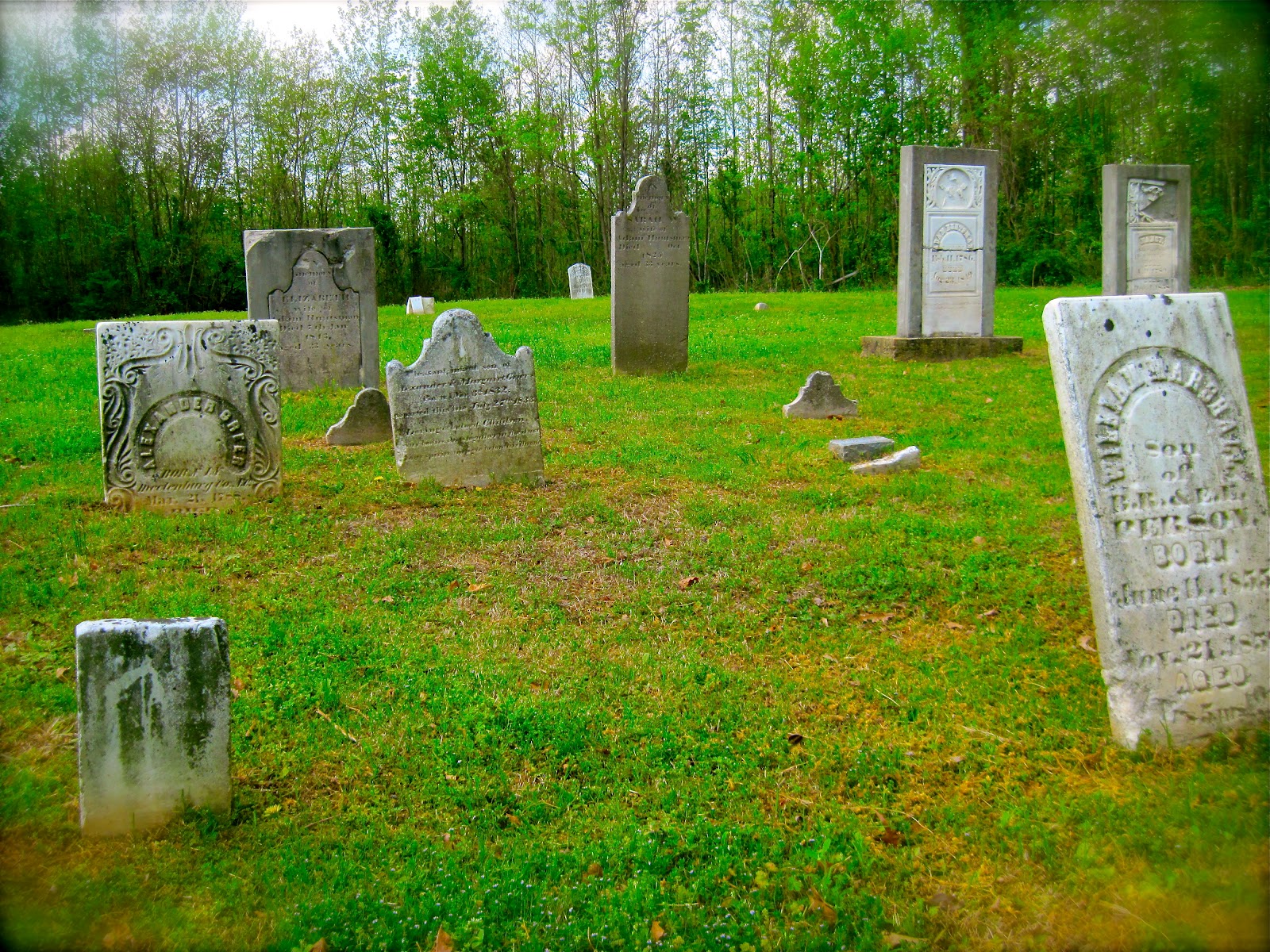
Many of the founders of Madison County, TN are said to be buried in the cemetery but the graves are unmarked today because of vandals removing the stone markers and deterioration of tombstones that were made of wood.

Click to Enlarge

Adam Huntsman

One such founder who made an interesting mark in southern history is Adam Huntsman. He is the man who defeated Davy Crockett for Congress in 1836 and inspired Crockett's famous quote, "Tennessee can go to Hell, I'm going to Texas." I blogged a while back about running into old Davy in Austin. I feel a close connection to Crockett since he is the father-in-law of the wife of my third great grandmother's first cousin.

Click to Enlarge

Headstone of Adam Huntsman, upper right

Huntsman served five terms in the Tennessee state senate and one term in the U.S. House of Representatives representing the 12th Congressional District. He had a wooden peg-leg as the result of losing a leg in an Indian fight during the Creek Indian War. He died 23 Aug 1849 and is buried at Salem Cemetery with all three of his wives.

Click to Enlarge


The cemetery also has a Civil War connection. On 19 Dec. 1862, a battle took place between General Nathan Bedford Forrest and some of his Confederate cavalry and the Union troops of Colonel Adolph Engelmann.

Click to Enlarge

Monument at Salem Cemetery and Battlefield

About 1,000 men were engaged in a four-hour battle resulting in the Union troops withdrawing to Jackson. By the time the Union back-up arrived, Forest and the Confederates were headed to Humboldt, TN.

Although I have no way of knowing if he took place in the battle, my second great grandfather, T. J. Castellaw, fought in the war as member of Duckworth's Tennessee Calvary so it's certainly possible he was there. It's on my list to research.

Click to Enlarge

Confederate Monument at Salem Cemetery and Battlefield

When the smoke cleared, 65 of the Confederates were killed, wounded or missing while the Federals had only two soldiers killed and six wounded.

Click to Enlarge

Monument to Union Soldiers at Salem Cemetery and Battlefield

The site includes several historical markers and monuments and even has a covered area which has lots of information about the area via articles inserted in plastic sleeves and pined to a bulletin board; low tech for sure...but it works.

Below is a short video of the area I grabbed while there. For some reason, I used a funky filter I had on my ipad which made it look like I shot the video in 1965.


In case you want to check it out youself, the address of the New Salem Cemetery and Battlefield is 58 Cotton Grove Rd., Jackson, TN 38305.

For more blog entries, visit my Blog Home Page or to check out the genealogy research about my specific family lines, go to Haywood County Line Genealogy Page.